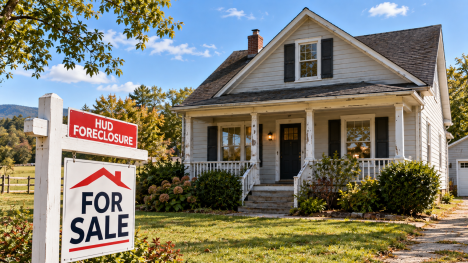
Every once in a while, a buyer calls me about a house that's noticeably cheaper than everything else in the neighborhood. Same number of bedrooms, decent location, maybe even a nice backyard. But there's something unusual in the listing: three little letters — HUD.
"Robert, what's a HUD home? Is it government housing? Do I have to qualify for some special program? And why is it so cheap?"
Fair questions. After 30 years working in Northern California real estate, I've learned that government-owned properties can confuse even experienced buyers. The process looks familiar until suddenly it doesn't. Different bidding rules, unusual paperwork, utilities that might be disconnected, and a seller who isn't particularly interested in hearing about your dream of raising a family there.
But here's the good news: HUD homes can offer some genuinely interesting opportunities for ordinary homebuyers. You don't have to be a professional investor or have a suitcase full of cash. You just need to understand what you're buying and how the process works.
So let's explain HUD homes the way I'd explain them to a first-time buyer sitting across from me at the kitchen table. No government alphabet soup. No unnecessary complications.
First, What the Heck Is a HUD Home?
Imagine your neighbor buys a house using a mortgage insured by the Federal Housing Administration, or FHA.
A few years later, something goes wrong financially. Maybe there's a job loss, a divorce, or another hardship. The homeowner stops making mortgage payments, and eventually the property goes through foreclosure.
Because the mortgage was FHA-insured, the lender may make an insurance claim and transfer ownership of the property to the U.S. Department of Housing and Urban Development — HUD.
Now the government owns a house.
Does the government want to become a landlord and maintain that house forever? Generally, no. It wants to sell the property and recover money for the insurance fund.
That's a HUD home.
It's a regular house that ended up in government ownership after an FHA-insured mortgage foreclosure.
It could be a cute three-bedroom ranch. A two-story suburban home. A townhouse. A property that needs a new kitchen. Or one that's perfectly livable and just needs somebody to mow the lawn.
And no, buying one doesn't mean you're moving into public housing. You're buying a property, just as you would in an ordinary real estate transaction.
Why Are Some HUD Homes So Cheap?
Let's clear up the biggest misconception immediately: HUD homes are not automatically bargains.
HUD generally prices its properties based on their appraised value in their current condition. That last part matters.
A comparable house down the street might sell for $350,000. But if the HUD property needs a roof, new flooring, appliances, plumbing repairs and serious landscaping, its asking price could be considerably lower.
That's not necessarily a discount. That's the market accounting for work that still needs to be done.
On the other hand, government-owned properties sometimes sit longer than expected, particularly when they're unattractive to buyers who want something move-in ready. Prices can be reduced, and eventually a property may become a much more interesting purchase.
I've always liked looking at houses other buyers dismiss too quickly. Ugly carpet doesn't frighten me. Outdated wallpaper doesn't frighten me. A yard full of weeds is practically an invitation to investigate.
A failing foundation? That's a different conversation.
The trick is knowing the difference between a cheap-looking house and a house that's genuinely cheap for what you're getting.
Does a $41,000 Price Reduction Mean $41,000 in Instant Equity?
Here's a real question from a first-time buyer that perfectly illustrates the confusion.
The buyer toured a HUD home originally listed for $270,000. After bouncing on and off the market for about a year, the asking price had dropped to $229,000.
Naturally, the buyer wondered: "If it was worth $270,000 before, and I can buy it for $229,000 now, doesn't that mean I'm getting $41,000 in instant equity?"
I wish it worked that way.
The original asking price is not proof of what a property is worth.
Maybe the original price was too high. Maybe buyers discovered expensive repairs. Maybe financing repeatedly fell apart. Or maybe the market changed.
Let's do the math.
Suppose you buy that house for $229,000, and comparable properties in similar condition support a current value of $235,000.
Your apparent purchase-price advantage is $6,000, not $41,000.
Now suppose the house needs $25,000 in repairs. Your total investment before closing costs and carrying expenses becomes $254,000.
If those repairs raise its value to $280,000, you might have created a meaningful equity cushion. But if the finished property is only worth $255,000, there's very little room left after expenses.
That's why I never evaluate a distressed property by comparing today's asking price with yesterday's asking price.
I compare it with what the house is realistically worth today, what it will cost to make it livable, and what it should be worth afterward.
A big price reduction is a reason to investigate, not a reason to celebrate.
Can Anyone Buy a HUD Home?
Generally, yes, provided you're eligible under the applicable sale rules and can pay for the property.
But there's an interesting twist that makes HUD homes particularly attractive to people who actually want to live in them.
For certain HUD listings, owner-occupants receive an exclusive bidding period before ordinary investors can compete.
An owner-occupant is simply someone buying the property to use as their primary residence rather than immediately renting or flipping it.
Under HUD's 2025 policy change, the exclusive listing period for applicable HUD-owned properties returned to 15 days, replacing the previous 30-day period. Other priority rules and property classifications may apply, so always check the specific listing.
Why does that matter?
Because in a normal real estate market, a first-time buyer with FHA financing might be competing against a cash investor who can close quickly and doesn't care about replacing a water heater.
With an eligible HUD listing, the buyer planning to live in the house gets an early opportunity.
I wouldn't call that a guarantee of winning. You're still competing with other eligible buyers. But it's an advantage worth understanding.
And don't try to claim owner-occupant status if you're actually purchasing an investment property. HUD's occupancy requirements are real, and misrepresenting your intentions can have serious consequences.
Where Do You Find HUD Homes for Sale?
Start with the official HUD Home Store.
This is the government's listing and bidding platform for HUD-owned properties. You can search for available homes, review their status, examine property information and see applicable bidding details.
Many HUD homes also appear on ordinary real estate listing websites and in the Multiple Listing Service, or MLS.
But here's something I recommend: when you find an interesting HUD property on a regular listing website, go back to the official HUD listing to check the details.
Pay particular attention to the property's status, bidding deadline, eligibility period and financing classification.
Those details can determine whether you can submit an offer today, whether you're eligible to compete, and whether your planned mortgage is suitable.
Why Can't I Just Call HUD and Buy the House?
Because HUD generally sells these homes through registered real estate brokers.
You can search the listings yourself. You can study the photographs and property information. You can even decide exactly what you want to offer.
But when it's time to submit the bid, you'll normally need a HUD-registered real estate broker.
And I'd strongly recommend finding somebody who's handled HUD transactions before.
One retired real estate agent discussing HUD purchases offered a wonderfully practical test: ask your agent whether they're familiar with HUD's NAID registration requirements and the specific paperwork.
The agent even joked about keeping a blue pen handy because HUD's document-signing requirements could be unusually particular.
Now, don't assume every old paperwork requirement still applies. Procedures change, and electronic signatures are increasingly common.
But the larger lesson is excellent: your agent should know the HUD process before your money is on the line.
A good agent can explain why one listing is available to owner-occupants while another is open to investors, or why a seemingly reasonable offer might not be accepted.
This is one of those transactions where experience with the specific process is more useful than a fancy business card.
How Does the HUD Bidding Process Work?
This is where things get interesting.
With a typical home sale, you submit an offer. The seller might accept it, reject it, or negotiate with you over price, repairs and closing terms.
HUD sales are more structured.
Your registered broker submits your bid electronically. HUD reviews eligible bids according to the rules for that property and bidding period.
And here's the detail people often overlook: HUD generally evaluates the net amount it receives, not simply the biggest number written on the offer.
For example, consider two hypothetical offers:
- Buyer A: Offers $205,000 and requests $6,000 in seller-paid costs.
- Buyer B: Offers $202,000 and requests no seller-paid costs.
Ignoring other applicable expenses, Buyer A produces $199,000 before common selling costs. Buyer B produces $202,000.
So the lower-priced offer could actually be more attractive to HUD.
That doesn't mean you should automatically waive assistance or bid above your budget. It means you and your agent should understand how your offer is evaluated before submitting it.
Also, don't assume you'll receive the kind of back-and-forth negotiation you might expect from an ordinary homeowner. HUD may issue counteroffers under applicable rules, but the process isn't an informal conversation with a seller across the kitchen table.
Why Won't HUD Accept My Offer?
Here's a frustrating situation worth understanding.
A couple found a HUD-owned house listed at $136,800 after previously being offered at $157,000. The house had been on the market for months, and an earlier sale appeared to have fallen through.
They liked the layout and believed the structure was sound, but the interior needed substantial cleaning and improvement.
They submitted multiple offers, starting at $80,000 and eventually working their way above $100,000. Again and again, their bids were rejected.
You can imagine the frustration. A property has been sitting for months. It needs work. You're ready to buy it. Why won't the government take your money?
Here's the thing: HUD doesn't necessarily lower its acceptable price just because a buyer thinks the house has been sitting too long.
Its pricing and bid decisions follow established procedures and financial considerations. The price HUD previously paid or recorded for a property isn't necessarily the amount it must accept from the next buyer.
Sometimes a lower offer becomes acceptable after additional marketing time or a price adjustment. Sometimes it doesn't.
My advice? Decide what the house is worth to you, accounting for repairs and risk. Submit a defensible offer. If it doesn't work, keep looking or revisit the property if circumstances change.
Don't negotiate against yourself indefinitely because you've become emotionally attached to a house with dirty carpets.
What Does "As-Is" Actually Mean?
This may be the most important part of the entire article.
HUD homes are generally sold as-is.
In plain English, you're buying the property in its existing condition, and HUD generally isn't going to fix its problems for you.
If the dishwasher doesn't work, that's your problem.
If the roof needs replacing, that's your problem.
If you discover an expensive plumbing issue after closing, you generally shouldn't expect HUD to write you a check.
One retired agent made an observation I think every buyer should understand: homeowners who fall behind on mortgage payments may also have trouble paying for routine maintenance.
That doesn't mean every foreclosed home is neglected. But it means you should take deferred maintenance seriously.
A house can look perfectly presentable while hiding years of postponed repairs.
And unlike buying from a homeowner who's lived there for 15 years, you usually won't have somebody available to explain that the upstairs bathroom occasionally leaks or the furnace makes a strange noise every December.
Which brings me to my favorite piece of advice for distressed-property buyers:
Never confuse a low asking price with permission to skip due diligence.
Before You Bid, Read the Property Condition Report
HUD properties may come with a Property Condition Report, commonly called a PCR.
Think of it as a document describing known or observed problems with the property.
It may identify damaged systems, missing components, structural concerns or other issues discovered during HUD's property evaluation.
Read it before submitting an offer.
Then read it again.
Why am I making such a big deal about this?
Because buyers sometimes discover that a problem mentioned in the PCR becomes important later when they're trying to cancel a purchase.
In one discussion, a buyer described finding serious foundation problems during an inspection. The PCR had reportedly included a vague warning that there might be structural issues requiring further investigation.
When the buyer sought an earnest money refund, the request was reportedly denied because the potential problem had already been disclosed.
That's an older buyer account, not a guarantee of how HUD would handle every similar situation today. The applicable contract and current rules control.
But the lesson is hard to miss.
If the report says "possible structural issues," don't translate that into "probably nothing."
Translate it into "I need to know what this could cost before I risk my deposit."
And remember: the PCR isn't a substitute for your own inspection. It may not identify every problem, and conditions can change while a property sits vacant.
Warning: An Inspection Period Doesn't Always Mean You Can Walk Away for Free
This is the part I wish every first-time HUD buyer understood before bidding.
In an ordinary home purchase, buyers often negotiate an inspection contingency. Depending on the contract, that may allow them to cancel during a specified period and recover their earnest money if the inspection reveals unacceptable conditions.
Don't assume a HUD transaction works the same way.
One buyer described winning a HUD bid and then discovering that the contract allowed a 15-day inspection period but did not automatically provide a right to cancel with an earnest money refund simply because the inspection uncovered problems.
That's a very important distinction.
Permission to inspect a house is not necessarily permission to cancel the contract without financial consequences.
The buyer's discussion also highlighted differences between owner-occupants and investors when seeking deposit refunds, as well as disagreements among commenters about contract provisions and local practices.
Because that account is from an older transaction, you should not assume its exact deadlines or refund rules apply to a current purchase.
What should you do instead?
Before submitting a bid, have your HUD-experienced agent explain the current contract's cancellation and earnest-money provisions. If the financial exposure is substantial or the language is unclear, consider having a real estate attorney review it.
Ask a very specific question:
"If my inspector finds a $25,000 foundation problem, can I cancel and receive my full earnest money deposit back? And exactly which contract provision gives me that right?"
Don't settle for "I'm pretty sure."
Get the answer from the actual documents.
That one conversation could save you a very expensive lesson.
What If the Utilities Are Turned Off?
This is a very real problem, and one that catches first-time buyers by surprise.
A couple toured a HUD home that looked remarkably good. Nice neighborhood, attractive price, and almost everything they wanted in a house.
There was just one complication: the utilities were disconnected.
That meant they couldn't easily confirm whether the furnace worked, whether the plumbing leaked under pressure, or whether the electrical system operated properly.
And that's a bigger issue than it first appears.
Imagine buying a car without being allowed to start the engine.
The paint looks good. The seats are comfortable. The price is attractive.
But you still want to know whether the engine works.
A house is no different.
Utility activation may be possible for an inspection or appraisal, but it requires coordination with the responsible property manager and utility providers, and it may involve costs, approvals or safety requirements.
Don't assume utilities will automatically be turned on simply because you request an inspection.
Before bidding, ask your agent what the specific property's rules allow, who handles activation, whether systems can be tested, and what happens if they cannot.
If you can't test major systems, price that uncertainty into your decision.
Can You Buy a HUD Home With an FHA Loan?
Yes, some HUD homes can be purchased using FHA-insured financing.
But not every HUD property qualifies for a standard FHA mortgage in its current condition.
You'll encounter classifications such as:
- Insured (IN): The property is identified as eligible for FHA-insured financing under the applicable program requirements.
- Insured with Escrow (IE): The property may qualify for FHA-insured financing with specified repairs handled through an approved repair escrow arrangement.
- Uninsured (UI): The property does not qualify for standard FHA-insured financing in its current condition.
That last classification doesn't necessarily mean you need cash. Depending on the property, lender and scope of work, an FHA 203(k) rehabilitation loan or another suitable financing product might be available.
A 203(k) loan can combine eligible purchase and renovation costs into one financing arrangement, subject to program requirements.
But renovation financing involves additional planning, documentation, contractor requirements and lender review.
And here's something I want you to understand: the fact that HUD owns a house doesn't automatically mean FHA will finance your purchase of it.
Ask your lender about the specific property's classification before you bid.
Do You Need a 20% Down Payment?
Not necessarily.
One older online explanation suggested that HUD buyers often need 20% down. That's not a universal HUD requirement.
Your down payment depends on the loan program, your qualifications and the property's eligibility.
If you're eligible for an FHA loan, the minimum required down payment may be as low as 3.5% for qualifying borrowers, subject to applicable credit and underwriting requirements.
Other financing programs have different down payment requirements.
And please don't spend every dollar you've saved on the down payment.
HUD properties can require repairs immediately after closing. You'll want reserves for unexpected expenses, particularly if you're buying a house that has been vacant for an extended period.
A low down payment is wonderful if it helps you become a homeowner. It's not wonderful if it leaves you unable to replace a failed water heater two weeks later.
Can You Really Walk Into a HUD Home With Equity?
Sometimes. And this is the part that makes me optimistic about the program.
One buyer described purchasing an extremely inexpensive HUD property that needed substantial work, including major mechanical and plumbing replacements.
After repairs, the buyer reported having roughly $14,000 invested in making the property livable, with a later appraisal around $70,000.
That's an unusually dramatic example, and it shouldn't be treated as a typical outcome. It also doesn't tell us everything about the buyer's labor, timing or other expenses.
But it illustrates why distressed properties attract people willing to do the homework.
Another buyer described reaching the closing process on a HUD home with an estimated $20,000 equity advantage, although the transaction involved considerable procedural headaches.
Now, estimated equity isn't cash in your pocket. Appraisals are opinions of value, and selling a house costs money.
Still, buying below the value of comparable properties can give a homeowner a useful financial head start.
That's why I wouldn't dismiss HUD homes simply because they're foreclosures.
Some are bad deals. Some are ordinary deals. And occasionally, one is exactly the opportunity a patient buyer has been waiting for.
What About Earnest Money and Closing Deadlines?
When your HUD bid is accepted, you generally need to move quickly on the required paperwork and earnest money deposit.
Earnest money is the deposit that demonstrates you're serious about completing the purchase.
HUD's published procedures specify deposits that commonly range from $500 to $2,000 for residential properties, depending on the sale price and applicable requirements.
The deposit is generally credited toward the purchase at closing, but it can be subject to forfeiture if the buyer fails to complete the transaction under the governing terms.
One experienced agent warned that buyers should be ready to deliver the signed contract package and deposit promptly after a winning bid.
The exact deadlines depend on the current transaction requirements, so don't rely on a timetable from an old online discussion.
And here's another detail worth remembering: the party holding earnest money can vary by transaction and jurisdiction. It may be an escrow or title company, attorney, or authorized brokerage, depending on the applicable arrangements.
Don't assume your real estate agent personally holds the money or has the authority to decide whether it's refundable.
Before bidding, understand who receives the deposit, when it's due, the circumstances under which it may be forfeited, and how a dispute would be resolved.
I tell buyers to have their financing documentation, proof of funds, identification and deposit arrangements ready before bidding.
Don't wait until your offer is accepted to start figuring out where your paperwork is.
Can HUD Help Pay Your Closing Costs?
Sometimes.
For eligible transactions, HUD may allow buyers to request contributions toward financing and closing costs, generally up to the applicable program limit, which HUD describes as up to 3% on many sales.
But remember our earlier discussion about net offers.
If you request $6,000 in closing-cost assistance, that generally reduces what HUD receives from your bid.
So don't automatically request the maximum just because it's available.
Ask your lender how much assistance you actually need, and work with your agent to understand how the request affects your competitiveness.
Sometimes a slightly higher purchase price with assistance makes sense for your cash flow. Sometimes a cleaner offer is more attractive.
There's no universal answer.
The Seven Biggest Mistakes HUD Buyers Make
After looking at the opportunities and frustrations buyers encounter, I'd put the biggest mistakes into seven categories.
- Assuming the house is automatically a bargain. A $41,000 price reduction doesn't prove you're getting $41,000 in equity.
- Choosing an agent unfamiliar with HUD transactions. The bidding, documentation and deadline requirements are different enough to matter.
- Ignoring the Property Condition Report. Read disclosed defects carefully and investigate anything potentially expensive.
- Assuming an inspection guarantees a free exit. Understand the current contract's cancellation and earnest-money rules before bidding.
- Ignoring the utility situation. A beautiful-looking house with untested plumbing and electrical systems can hide expensive problems.
- Falling in love before understanding the financing. Confirm that the property works with your intended loan program.
- Spending all available cash on the purchase. Keep money for repairs, maintenance and unexpected closing expenses.
I'd add one more warning: don't assume that a government seller will be more forgiving than an ordinary homeowner.
Quite often, the process is more rigid.
Deadlines matter. Paperwork matters. Eligibility matters. Contract language matters.
Being organized is a genuine advantage.
My Practical HUD Home Buying Checklist
If I were helping a first-time buyer evaluate a HUD property, this is the order I'd want things handled:
- Find the property on HUD Home Store and confirm its current status.
- Review comparable sales to estimate its realistic market value.
- Find a HUD-registered agent with actual experience handling these transactions.
- Read the Property Condition Report and investigate potentially expensive defects.
- Review the financing classification and speak with a lender before bidding.
- Investigate the utility status and whether a meaningful inspection can be completed.
- Understand the inspection, cancellation and earnest-money provisions before making an offer.
- Estimate repairs conservatively, including a contingency.
- Calculate your maximum comfortable offer, not merely the maximum you can borrow.
- Have the required deposit and documentation ready before submitting your bid.
Notice what's missing?
Nowhere did I say, "Find the cheapest house and offer as much as possible."
Price matters. But value, condition, financing and risk matter just as much.
So, Are HUD Homes Worth Buying?
Absolutely — under the right circumstances.
A HUD home isn't automatically better than a regular listing. It isn't automatically worse, either.
It's a property being sold through a different system, often with less information about its history, stricter procedures and fewer opportunities to negotiate repairs.
In return, you may find a property with less competition from investors during the applicable owner-occupant priority period, an attractive purchase price, or an opportunity to build equity by making sensible improvements.
And sometimes you'll find a house that looks promising until the inspection reveals enough problems to make walking away the smartest decision — even if doing so requires careful consideration of your contractual obligations.
That's okay.
A successful home search isn't measured by how many offers you win. It's measured by whether you eventually buy a home that makes financial and practical sense.
Here's my final advice: don't be afraid of HUD homes, but don't romanticize them.
Look past the peeling paint. Investigate the expensive stuff. Read the Property Condition Report. Understand the contract before bidding. Keep some cash in reserve. And don't let an attractive asking price talk you into accepting risks you don't understand.
If the numbers work, the house is sound enough for your plans, and you can comfortably afford both the purchase and the repairs, a HUD home can be a terrific way to become a homeowner.
Sometimes the best house on the block isn't the prettiest one when you first see it.
Sometimes it's the one everybody else overlooked — and you were smart enough to recognize what it could become.