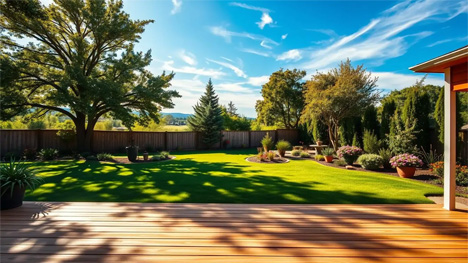
Put "big backyard" on a wish list and everyone pictures the same thing: open grass, room to breathe, somewhere for the dog to run. It is one of the most requested features in residential real estate, and for good reason. What the picture leaves out is the second half of the deal - the Saturdays, the equipment, the water bill, and the honest question of how often the space actually gets used.
Below is the trade-off laid out in full, so you can work out whether a large lot fits the way you really live rather than the way you imagine you will.
What Makes Buyers Fall for the Lot
1. Somewhere for Kids and Dogs to Burn Energy
Room to run is hard to substitute. A deep lot gives children and pets a safe place to be loud and messy, and it makes swing sets, a trampoline, a vegetable bed or plain open turf possible without crowding the house. For a lot of families the yard ends up functioning as an extra room the family actually uses.
2. Distance from the Neighbors
Square footage of land buys separation. More space between structures means less of your neighbor's music, fewer sightlines into your windows, and a quieter place to sit at the end of the day. In dense suburbs that buffer is often the real luxury, not the grass itself.
3. A Blank Canvas for Outdoor Living
With acreage comes the option to build the outdoor life you want: a patio, a fire pit, a covered dining area, an outdoor kitchen, a pergola for shade, a court or a pool. Owners who use their yards this way often describe them as the part of the property that makes the house feel like theirs.
4. Space for the Hobby You Cannot Do Indoors
Raised beds, fruit trees, a greenhouse, serious landscaping, a workbench under a shed roof - none of these fit on a patio. If working with your hands outside is how you unwind, a small lot puts a hard ceiling on it and a large one does not.
5. Optionality You Cannot Add Later
Land is the one component of a property you cannot bolt on afterward. A deep lot leaves the door open for a detached garage, a workshop, a studio, or a guest suite or accessory unit if local zoning allows. Needs change over ten or twenty years, and extra ground is what lets the property change with them.
The Half of the Deal Nobody Mentions at the Showing
1. The Yard Becomes a Standing Appointment
Mowing, edging, watering, weeding, pruning, fertilizing, raking, hauling branches after a storm. During the growing season a large lot can absorb several hours a week, every week. It stops being a feature and starts being a chore roughly the moment the novelty wears off.
2. Recurring Costs That Nobody Quotes You
A bigger yard means a bigger mower and the fuel and repairs that come with it, irrigation to install and winterize, a heavier summer water bill, mulch and seed and fertilizer, pest treatment, and - for many owners eventually - a monthly landscaping crew. Individually these are small numbers. Annually they are not.
3. You May Only Get to Use It Half the Year
Climate quietly decides how much of that land you actually enjoy. Long summers of extreme heat, harsh winters, a rainy season or heavy humidity can shrink the usable window to a few pleasant months - while the watering, mowing and cleanup obligations stay on the calendar regardless.
4. It Does Not Automatically Help at Resale
A large lot is a strong selling point to one kind of buyer and a deterrent to another. Plenty of shoppers - downsizers, busy professionals, anyone burned by a previous yard - specifically screen for low maintenance. Whether the land adds to your sale price depends entirely on who is shopping in your market.
5. More Ground, More Visitors
Bigger yards attract more wildlife, and not all of it is welcome. Moles and gophers tunneling through the lawn, deer eating the garden, raccoons in the trash, ticks and mosquitoes in tall grass, wasps under the eaves. Managing all of that is another line on the maintenance list.
The Same Yard, Five Different Verdicts
Families in the Thick of It
When there are young children or an energetic dog in the house, the yard tends to earn its keep daily. Owners in this stage rarely regret the space - the upkeep is the price of a safe place to send everyone outside.
People Who Host
If your social life runs through cookouts, birthdays and holiday gatherings, a large yard effectively doubles the size of your house a dozen times a year. That is real value, and it is hard to replicate anywhere else.
Gardeners and Tinkerers
For anyone who considers yard work a pastime rather than a task, the arithmetic inverts entirely. The maintenance column of this list reads as the reason to buy the place, not the reason to hesitate.
People with No Spare Weekends
Long hours, frequent travel or a demanding stretch of career turn a big lot into a source of low-grade guilt. The grass grows on its own schedule, and a yard you never sit in still has to be mowed.
Downsizers and Anyone Simplifying
Priorities shift. Buyers in this group often trade land deliberately for a courtyard, a small patio or a maintained community lot, and describe the reduced obligation as the best part of the move.
Six Questions to Answer Honestly Before You Commit
- How many hours a week are you genuinely prepared to spend on yard care, in July?
- Have you priced the ongoing side of it - equipment, irrigation, water, treatments, possible lawn service?
- Realistically, how many days a year will you be out there using the space?
- Does your local climate give you a long enough season to justify the work?
- Are you buying privacy, or buying grass? A screened, smaller lot may deliver the first without the second.
- In your market, does a big lot help or hurt when it is your turn to sell?
A large backyard behaves like any other major lifestyle commitment: the upside is real, and so is the obligation attached to it. For one owner it is the place the family ends up every evening. For the next it is an expanse that quietly consumes weekends and never quite gets enjoyed.
So the useful question is not whether big yards are good. It is whether this yard matches your calendar, your budget and the next decade of your life. When it does, few features pay you back more. When it does not, all that green space becomes the most expensive thing on the property to ignore.